


The Silence
06 Oct 2025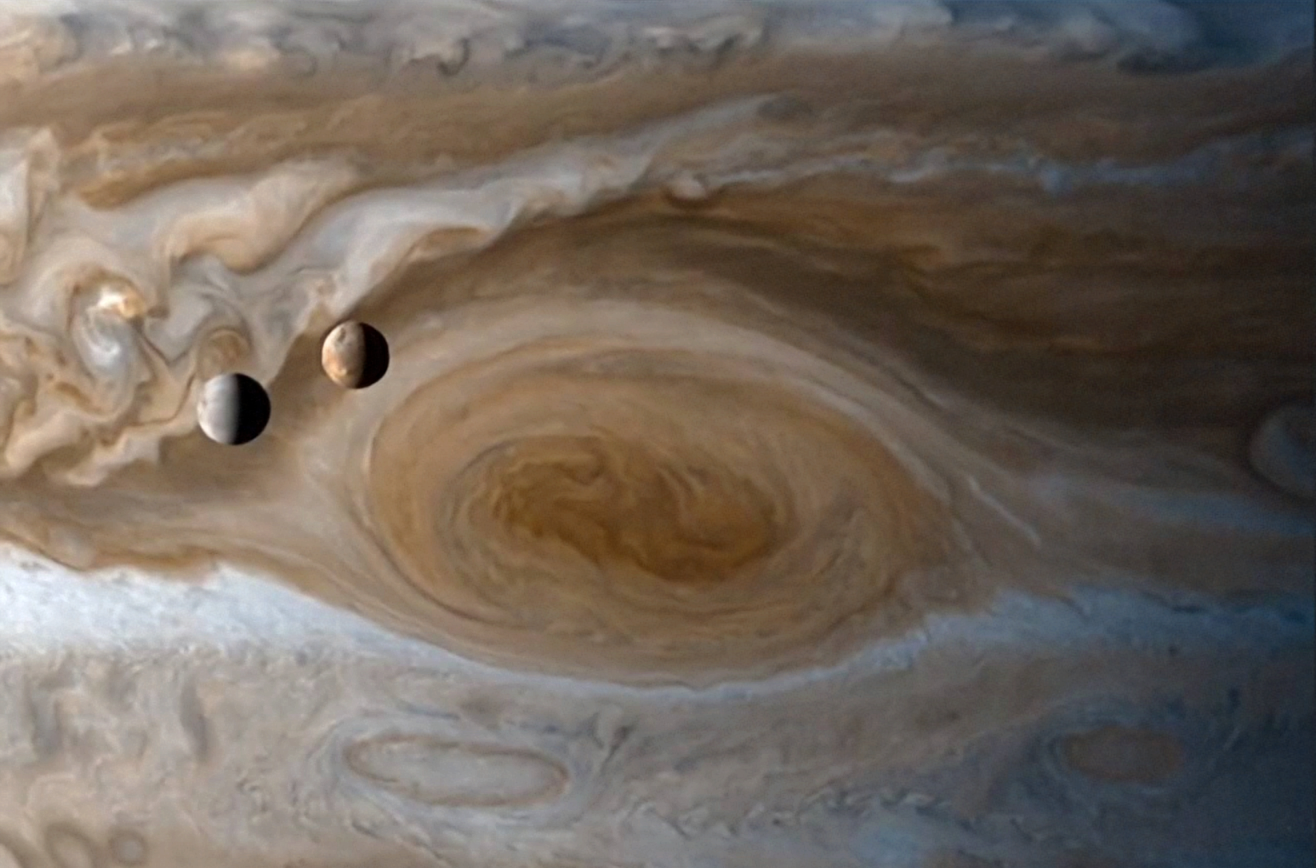
Dr. Amara Osei pressed her palm against the observation deck’s bio-responsive glass, and it shifted from opaque to transparent at her touch. Jupiter filled her vision: bands of crimson and ochre churning in storms that had raged since before humans walked upright.
Behind her, the fusion cores of Prometheus Station maintained their perfect hum, their deuterium-helium reactions so precisely controlled they could run for years without any human maintenance required.
You’ve been standing here for two hours.
She turned to find Dr. Marcus Reeves floating through the doorway, his pale skin lined with the kind of age that people chose now rather than endure. He’d opted to look seventy because he said it made younger colleagues take him seriously. His silver hair was tied back, and he moved with the practiced grace of someone who’d spent forty years in space.
The Enceladus probe sent its final data burst.
Marcus stopped his forward momentum with one hand on the wall rail. He was quiet for a moment, and she watched him understand without having to say it. They’d worked together for ten years. He knew what she’d been hoping to find.
Tell me.
Amara pulled up the holographic display, and the data bloomed between them in layers of spectroscopic analysis and molecular mapping.
The subsurface ocean is there, just like the models predicted. 273 Kelvin, liquid water, complex carbon chains forming spontaneously in hydrothermal vent systems. We found amino acid precursors, lipid-like structures, everything that should lead to self-replicating chemistry.
But?
But it never crosses the threshold. The chemistry stays complex but never becomes alive. It’s like watching someone walk toward a door forever without ever reaching it.
Marcus studied the data, his enhanced eyes, grown from his own stem cells in a lab on Mars, scanning faster than she could follow.
Mars, Titan, Europa, Enceladus. Sterile worlds with all the right conditions. Maybe in a few millions years, if the conditions don’t change… but we won’t be here to see it. Looking in another solar system would take decades… I asked the ASI collective to run the full probability analysis again. I gave it every data point we have: every dead ocean, every silent planet, every empty radio frequency we’ve monitored for more than a hundered years.
Amara—
One technological civilization per galaxy per cosmic epoch, Marcus. Maybe. The ASI calculated our existence at probability less than ten to the negative forty-seven. We’re not special because we’re advanced. We’re special because we’re a statistical impossibility that happened anyway.
Through the viewport, a cargo ship passed in the distance, its hull made of programmable matter that shifted configuration as it maneuvered. Its fusion drive left no exhaust—perfect conversion of mass to energy, Einstein’s equation made mundane. She watched it dock with one of the agricultural satellites that fed the Jovian colonies, the whole process automated, flawless, boring.
Do you remember, when you were young? When you first looked up at the stars?
She did. She’d been seven years old in Lagos, before the climate stabilization, when the stars were still hard to see through the atmospheric haze. Her grandmother had taken her to the coast, away from the city lights, and shown her the Milky Way.
Somewhere out there, someone is looking back at us.
I remember. I spent my whole life believing that. Every paper I published, every probe I designed, every grant proposal—it was all built on the assumption that we’d find them eventually. That we just hadn’t looked hard enough, or far enough, or in the right way.
And now?
Now we’ve looked everywhere we can reach. We’ve solved the physics, Marcus. Life isn’t rare because the universe is hostile to it. It’s rare because the needle’s-eye is so impossibly narrow. We threaded a billion coincidences, and no one else did.
Marcus moved closer to the viewport, his reflection ghostly in the glass. Beyond him, Jupiter’s Great Red Spot, still raging after four hundred years of human observation, swirled in its eternal dance.
I was there when the ASI solved the final field equations. I was in Geneva when they unified quantum mechanics and gravity. Do you know what I felt?
What?
Relief. I thought, finally, we’ll understand how everything works. And then we can focus on the next mystery: finding our neighbors in the cosmos, learning from civilizations older than ours, comparing notes on how they saw the universe. The universe doesn’t have mysteries anymore, Amara. Just observations. All the equations balance. All the conjectures are resolved. We can build anything, explain anything. And we’re still alone.
The weight of it pressed down on her. Earth was a blue pinprick in the distance, eight billion people living in abundance that would have been unthinkable to their ancestors. The Martian colonies were self-sustaining cities now, their populations growing. Fusion had made energy free. Medicine was still expanding live expectancy—children born today would live past two hundred. Space travel was everyday live. Humanity had won every battle it had ever fought against nature.
Except the battle against cosmic loneliness.
I keep thinking about all those old stories. The ones we told ourselves when we didn’t know better. Ancient alien civilizations seeding the galaxy with life. Cosmic mysteries beyond our comprehension. Truths so profound that meeting aliens would expand our minds in ways we couldn’t imagine. But there’s nothing out there. We understood it all, and it’s just physics. Chemistry. Probability. We didn’t win some cosmic lottery—we’re the only ticket that was ever drawn.
Maybe we’re wrong.
We’re not wrong. That’s what makes it unbearable. I wanted to be wrong, Marcus. I wanted some brilliant postdoc to find a flaw in the calculations, some overlooked variable that would change everything. But the ASI doesn’t make mistakes. Not anymore. The math is perfect. The observations are consistent. The universe is comprehensible. And it’s empty.
Marcus was quiet for a long time. A maintenance drone drifted past the viewport, its tendrils extending to repair a micrometeorite impact on the station’s hull. It worked with autonomous precision.
So what do we do?
Amara watched Jupiter’s storm, trying to find words for the thing crystallizing in her mind. The storm was a hurricane larger than Earth, driven by heat from the planet’s core, governed by equations they’d solved a century ago. It would rage for millions of years more, grinding through its cycles with mechanical precision. No one would ever come from another star to witness it. No alien scientist would ever study it and compare it to storms on their home world. It was magnificent and utterly, devastatingly pointless.
We keep going. We reach every star we can. We spread to every planet where humans can live, and we terraform the ones where we can’t. We fill the silence with something.
With what?
With us. With whatever we can create. The universe doesn’t care that we exist, Marcus. It didn’t create us for a purpose. We’re a statistical fluctuation, a random walk that happened to produce observers. But we’re here anyway. And maybe that means something.
What does it mean?
I don’t know. But maybe being first means we have a responsibility. Not to find meaning. But to create it. To be the universe’s way of knowing itself. To be the ones that seed live throughout the galaxy.
They stood together in silence, two humans at the edge of everything their species had built. Outside the viewport, the solar system thrived with human presence: stations orbiting every major body, ships traveling between worlds, colonies growing on Mars and in the asteroids. Humanity had spread like a slow fire through the darkness, bringing light to places that had been cold and dead for billions of years.
It wasn’t what they’d dreamed of as children, staring up at stars and imagining first contact.
But perhaps it was enough.
Amara placed her palm on the viewport again, and the glass recorded her biometrics. A human being, standing on a station orbiting Jupiter in the year 2150, bearing witness to a storm that would outlive civilizations. The universe hadn’t asked for an observer. But it had one anyway.
Come on. The council meeting starts in an hour. They’ll want to know about Enceladus.
Let them know we found nothing. Again.
And what should I tell them we’re going to do about it?
She looked at him, then back at Jupiter, then at Earth in the distance, that impossible blue world where apes had looked up at the stars and decided to understand them.
Tell them we keep exploring. Because exploring is what we do.